

The Hidden Advantage of Using a Windows Tablet to Learn Faster
Most people don’t fail to learn new skills because they lack motivation. They fail because learning feels completely out of the way. When it feels like it’s something that’s pulling you out of sync with your normal work and life routines, it can be a cumbersome process to start up mentally.
You tell yourself you’ll start that course tonight. But by the time you sit down, open your laptop, and find where you left off… the spark that got set off is now gone. Tomorrow then becomes next week. There’s too much friction with your life to get started.
This is where having a Windows tablet quietly changes everything. What it does is it removes just enough of the resistance to take the first few steps at it. This helps learning feel easier to start, easier to continue, and most importantly, easier to repeat.
So how does this actually work in practice? Check out the full blog to learn more.
Full Blog: The Best Way to Learn New Skills Using a Windows Tablet
Learning stops being a “task” and starts becoming something you just do
The biggest shift is not a technical one. It’s a behavioral shift. This idea lines up with Stanford’s Fogg Behavior Model, which suggests that behavior is shaped in part by how easy something feels to do.
When you use a Windows tablet, learning stops feeling like something you need to plan around. It becomes something you can just pick up and continue from where you left off.
You’re not thinking about setting up your whole work or study desk when you’re about to hop on your tablet. It doesn’t have that added weight you feel to instantly lock in once you log into your laptop or desktop.
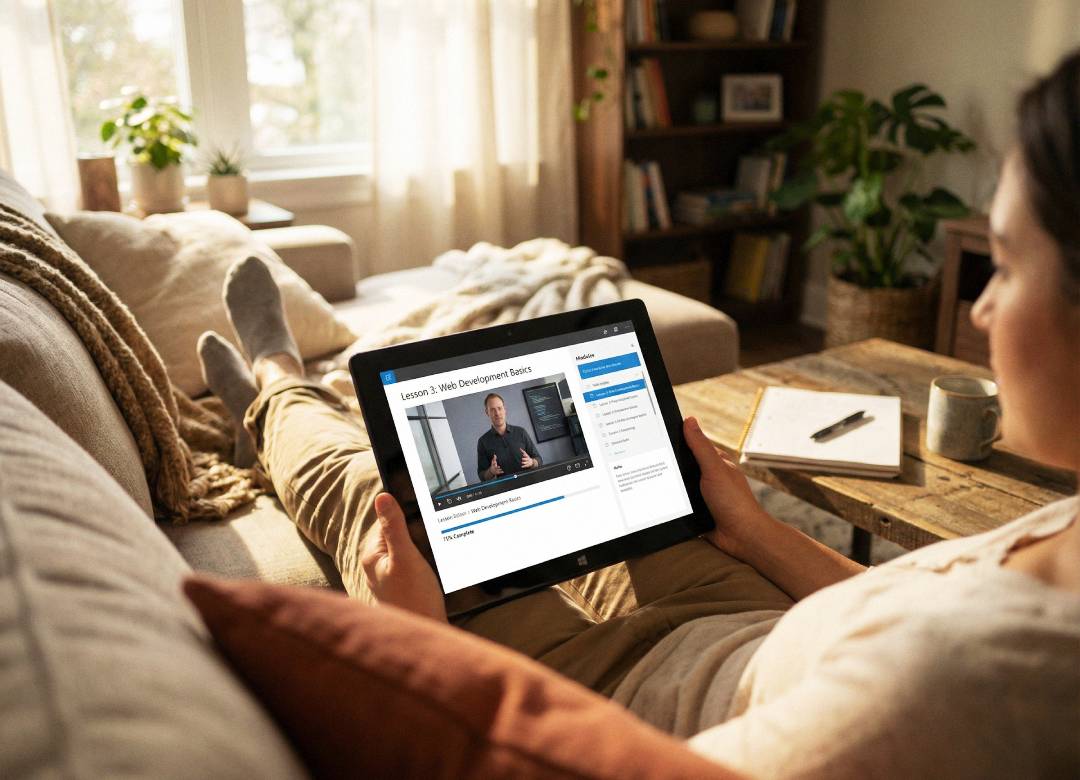
You can grab it right from your bag while you’re lying on the couch and get some learning going without ever getting up. You’re not thinking about where you left off. You’re not mentally preparing yourself to sit down and focus at a desk for an hour.
The ease of access makes the act of going out of your way to learn a lot more naturally flowing into your existing routine. This is something that can really help to remove friction in your routine building when you’re trying to form better habits. This idea also lines up with recent mobile learning research, which has found positive effects on learning gains.
You can learn where the skill is actually happening
One of the biggest shifts is where learning takes place.
Instead of learning in one place and doing the actual skill somewhere else, everything happens in the same space.
If you’re learning to sew, the tablet sits right next to the machine. You pause, replay, and follow along step by step while your hands are actually working. You’re not trying to remember what you saw five minutes ago. You’re just doing it in real time.
The same applies to cooking. Instead of checking your phone every few minutes with messy hands, you keep the tablet propped up and follow the recipe or video as you go. You move at your own pace without breaking your flow.
That alone removes a lot of the frustration that usually comes with learning something practical.
You stop watching and start doing straight away
A lot of people fall into the trap of watching too much and doing too little in between.
You watch five videos in a row, feel like you understand it, and then when you try it yourself, it doesn’t quite work as you thought it would.
With a tablet, that pattern changes.
You watch one step, try it out immediately, adjust, and keep going. That loop repeats over and over again.
Someone learning digital art might watch how to shade properly, try it right away, undo it, and try again until it feels right.
Someone learning Excel might see a formula, open a spreadsheet, and test it within seconds.
There isn’t much delay between the “see” and “do” processes. And that’s just what makes the learning a lot more likely to stick.
It fits into the small moments you usually waste
This is where most of the real progress happens.
Not in long sessions. In small ones.
You pick up your tablet for ten minutes in the morning and review something quickly. Later in the day, you come back for another short session. Maybe in the evening, you test something you learned earlier.
These are moments that would normally be lost to doom scrolling or doing nothing in particular other than killing your boredom.
Because a tablet is so easy to grab and open up, those moments turn into actual learning time without feeling like effort.
You keep everything in one place without breaking your flow
Another thing that slows people down is jumping between different tools.
Notes in one place. Videos somewhere else. Files scattered across tabs and folders.
It breaks your rhythm every time.
With a Windows tablet, everything can stay in one place.
You have your lesson open, your notes nearby, and your work right there with it. You’re not constantly switching contexts. You are staying in it.
That makes it easier to keep going once you start.
What this actually looks like over time
At first, it feels like you’re not doing much.
You pick up your tablet for ten minutes here and there. You follow along with a video. You try one small part of it yourself. You test a few things out just to see if you understand it all to move on to more complex things.
Nothing really feels like a big breakthrough until it all starts to build up over time.
You come back to it on the next day without thinking about it too much. Then again the day after. It becomes something you just open when you have a bit of time, not like something you have to totally commit to for an intense focus session, such as work.
After a while, you start noticing small changes. Things that used to feel confusing start to make more sense. You remember steps without having to go back and check over and over again. You make fewer mistakes when you try something new.
You’re totally getting it now.
Not because you suddenly put in a huge amount of effort, but because you kept coming back to it consistently without friction getting in the way.
It was never really about finding more time.
It was about making it easier to use the time you already had more to your own advantage.
Final thoughts
A Windows tablet doesn’t change what you’re already capable of learning.
What it changes is how easy it is to keep showing up for yourself.
It removes just enough friction to help you get started more often, continue for longer more easily, and repeat the process without overthinking it.
And when you repeat something enough times, that is when it turns into a real skill.
Check out our range of Windows tablets and discover how you can learn with less friction today.